Call Report preparation, built from your core and tied to your GL.
We prepare the quarterly NCUA 5300 Call Report workbook from your core, loan and general ledger data, reconcile it, and flag the variances before your CFO signs. What used to take three weeks becomes a review.
Kestrel Ridge Credit Union is a demonstration: a fictional institution with generated data.
The review package, page by page.
Every line of the 5300 that the ledger and core can fill, traced to the accounts behind it and tied before review. The credit union reviews and files; these are its working papers. Kestrel Ridge Credit Union is a demonstration: the institution is fictional and its data is generated, so every page can be shown in full. Our production code built the pages from its files, the way it builds a client's.
Swipe sideways to read across the page.
Is the Call Report ready to file?
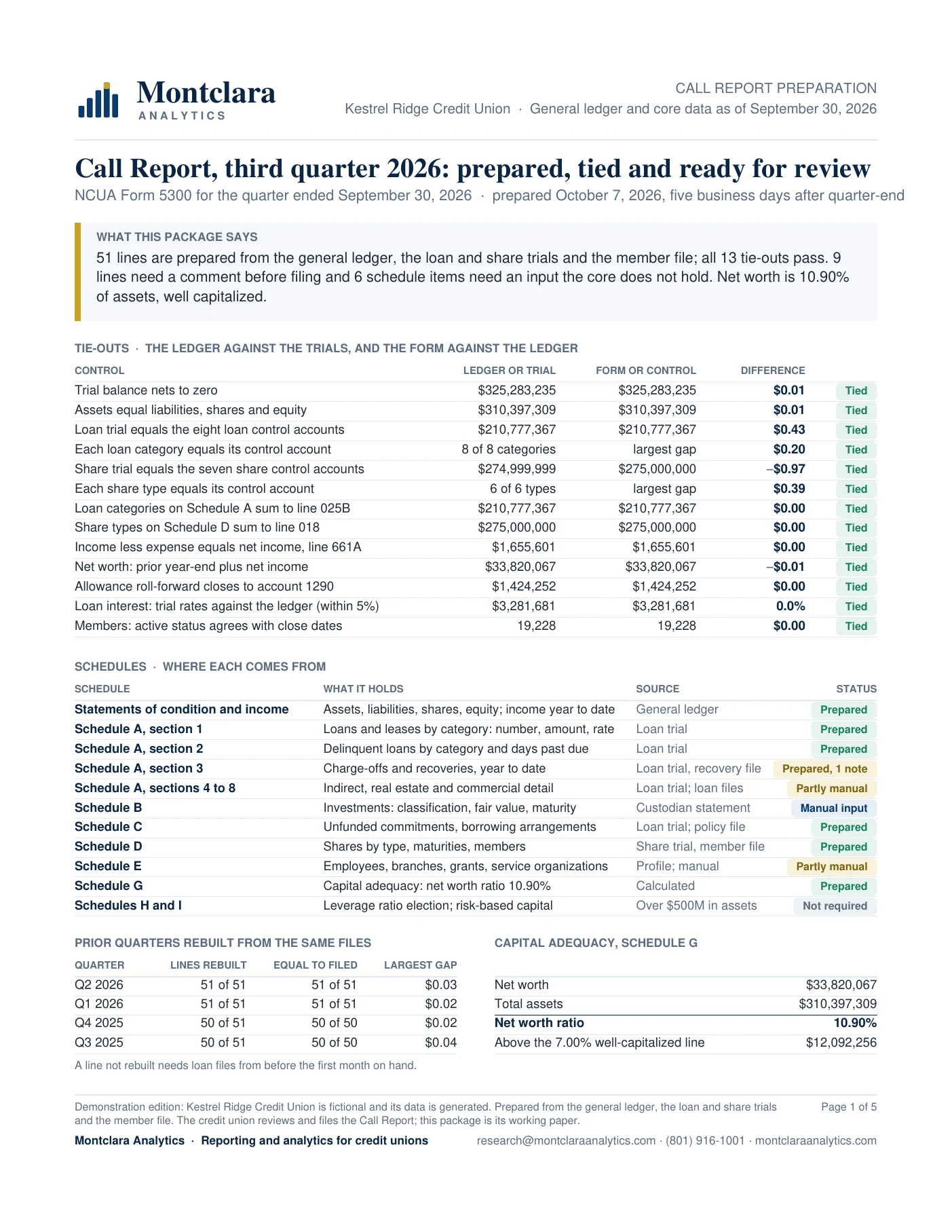
Thirteen tie-outs between the ledger, the trials and the form, where each schedule comes from, the last four quarters rebuilt from the same files, and capital adequacy.
From this page, on the demonstration credit union51 lines are prepared from the general ledger, the loan and share trials and the member file; all 13 tie-outs pass. 9 lines need a comment before filing and 6 schedule items need an input the core does not hold.
The same month-end produced three more packages.
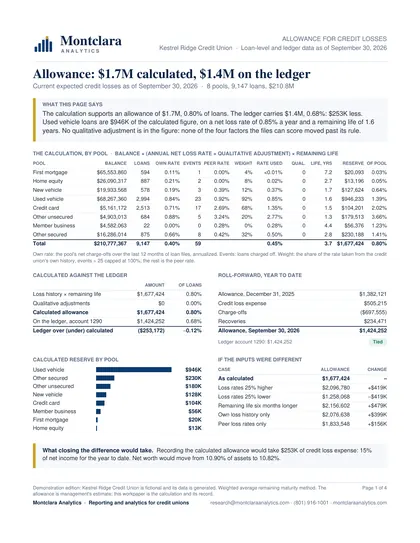
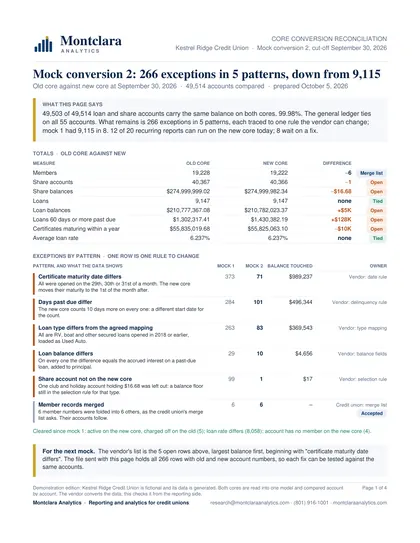
Kestrel Ridge's ledger, loan and share trials, member file and budget also built the board package, the allowance workpapers and the conversion reconciliation. All four are on one page.
Open the demonstration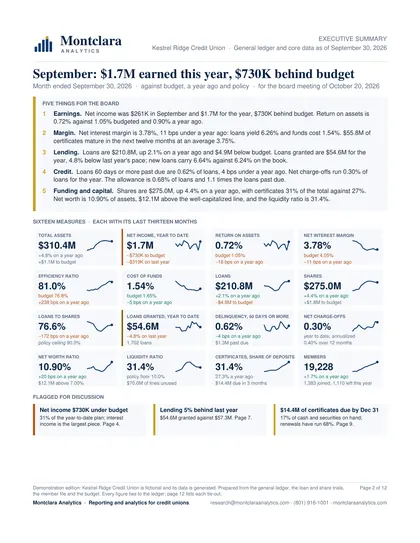
How the service works
The NCUA 5300 Call Report is the quarterly filing every federally insured credit union submits, and it is the single most time-consuming regulatory report most finance teams produce. We map your core, loan-origination and general ledger data to the Call Report schedules once, then regenerate the workbook every quarter from the same model. Each run reconciles loan and share totals to the GL, compares every line to the prior quarter, and produces a variance list for your review before anything is filed.
A fit if this sounds familiar
- Credit unions from $50M to $2B in assets whose Call Report is assembled by hand in Excel each quarter
- CFOs and controllers who want a second set of eyes on the numbers before filing
- Institutions approaching the $500M complex threshold who need the risk-based capital and CCULR schedules handled correctly
- Teams that have received examiner or auditor comments on Call Report accuracy
The quarter-end calendar once the mapping is live: the workbook arrives within five business days of quarter-end, leaving the rest of the window for review, questions and filing.
Where the capital measure NCUA watches most sits across the industry. The 7% line is the prompt-corrective-action threshold; every workbook we prepare computes the ratio and shows the trend against it.
Source: NCUA 5300 Call Report data, Q4 24–Q2 26, credit unions between $100M and $1B in assets. Montclara analysis.
Computed on every workbook and compared to the prior quarter; 7% and above is well capitalized under NCUA's prompt corrective action rules.
A line that moves more than 10% and clears a dollar floor is flagged with what the data shows about why; so is any move over $1 million.
Loans, shares, net worth and income must equal the general ledger before the workbook is released.
The workbook, reconciliation report and variance list arrive within five business days, leaving the rest of the window for review.
Every engagement includes
- Pre-filled 5300 workbook with every schedule mapped to your data, delivered five business days after quarter-end
- Reconciliation report showing loans, shares, net worth and income tied to the general ledger
- Quarter-over-quarter variance check flagging any line that moved more than 10%, with the explanation where the data shows one
- Net worth ratio, capital trend and, for complex credit unions, the RBC / CCULR worksheet
- Peer comparison against your NCUA peer group once the public data is released
- A documented mapping (account-to-schedule) you own, useful for examiners and auditors
From agreement to live
Discovery: your current Call Report process, prior filings, GL structure and data sources.
Read-only data access and first extracts; we reconcile your most recent filed quarter to the GL to validate the mapping.
Build and side-by-side review against your last two filed quarters until every line matches or the difference is explained.
Live: the workbook arrives five business days after quarter-end, with the variance list, for your review and filing.
What it costs
Call Report preparation is part of the Essentials package, from $2,950 per month, alongside the monthly board package, peer benchmarks and core dashboards.
If prior filings need correcting or the mapping needs to be rebuilt from scratch, a fixed-price project runs $5,000 to $12,000 depending on asset size and the number of quarters involved.
Annual agreements billed monthly. A one-time implementation fee applies to packages, from $7,500; a 60-day evaluation engagement is available and credited against implementation. See all packages.
What finance teams ask
Do you file the Call Report for us?
No. We prepare and reconcile the workbook; your CFO or designated officer reviews it and submits through NCUA's CUOnline. The accountability stays with the credit union, which is what examiners expect.
How do you handle schedule changes when NCUA updates the form?
We maintain the account-to-schedule mapping and update it when NCUA revises the form, usually a quarter ahead of the effective date. You receive a note describing what changed and why.
What if our core data doesn't support a line?
Some lines need inputs the core doesn't hold, such as certain investment or off-balance-sheet details. We mark those clearly in the workbook as manual inputs with a short instruction, so nothing is silently left blank.
Can you work from our last filing to check the mapping?
Yes, that is how every engagement starts. We rebuild your two most recent filed quarters from the data and reconcile them to what was submitted. Differences are documented before we go live.
See it built on data from your core system.
A 30-minute walkthrough of a sample deliverable, or a complimentary board package preview for your credit union first.