Converting cores? Keep every report, and prove every number ties.
We run your reporting on the old core and the new one side by side, reconcile them at every mock conversion and at go-live, and have the board package, Call Report and department reports working on the new system before its first month-end.
Kestrel Ridge Credit Union is a demonstration: a fictional institution with generated data.
A mock conversion reconciliation, page by page.
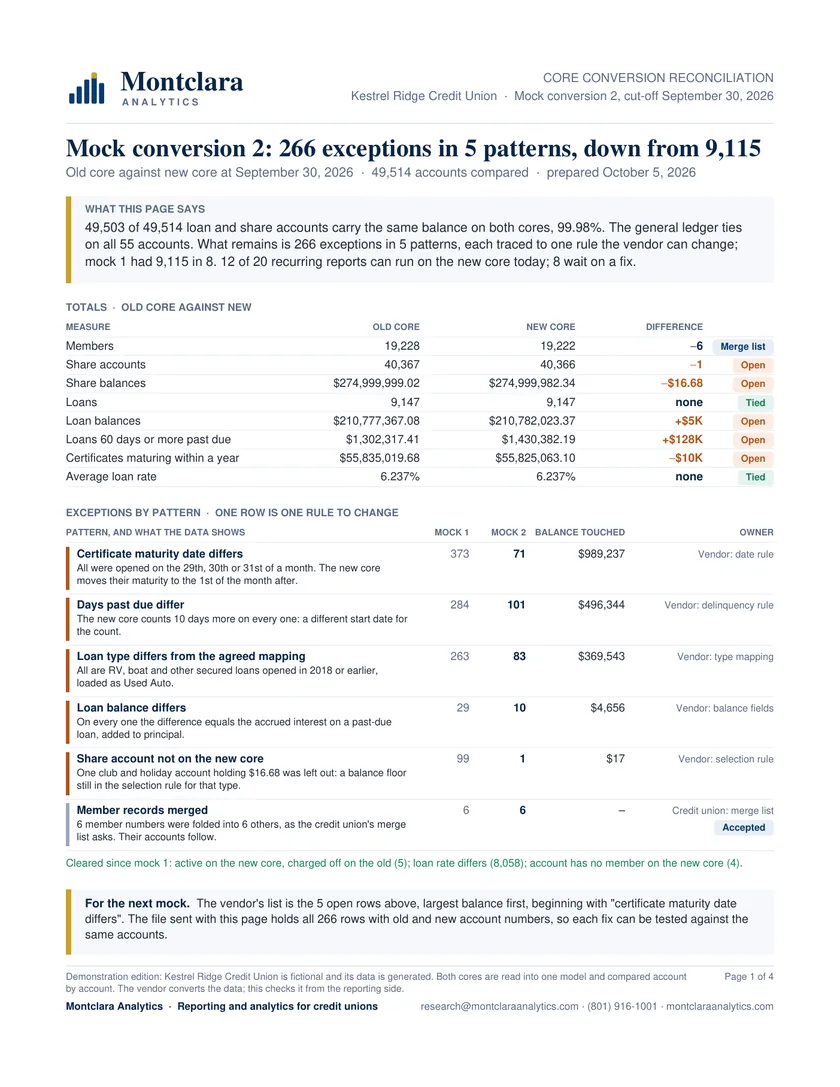
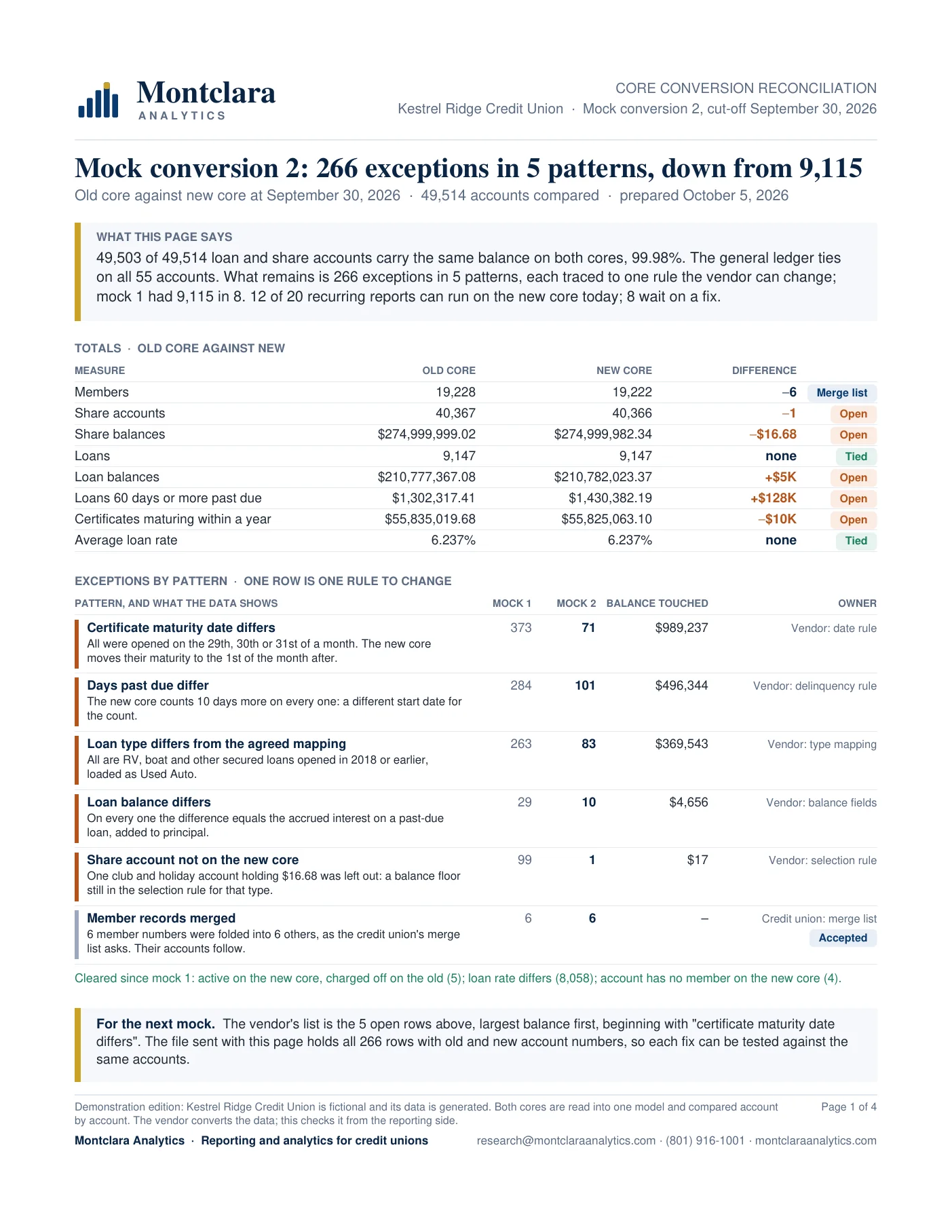
The second mock conversion: both cores read into one model, every exception traced to the rule behind it, and each recurring report marked ready or waiting on a named fix. Kestrel Ridge Credit Union is a demonstration: the institution is fictional and its data is generated, so every page can be shown in full. Our production code built the pages from its files, the way it builds a client's.
Swipe sideways to read across the page.
Did the mock conversion carry everything over?
Members, accounts and balances on both cores, every exception grouped into the rule behind it, what cleared since the last mock and who owns each fix.
From this page, on the demonstration credit union49,503 of 49,514 loan and share accounts carry the same balance on both cores, 99.98%. The general ledger ties on all 55 accounts.
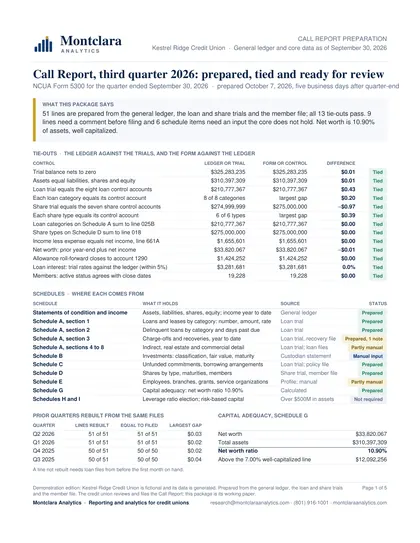
The same month-end produced three more packages.
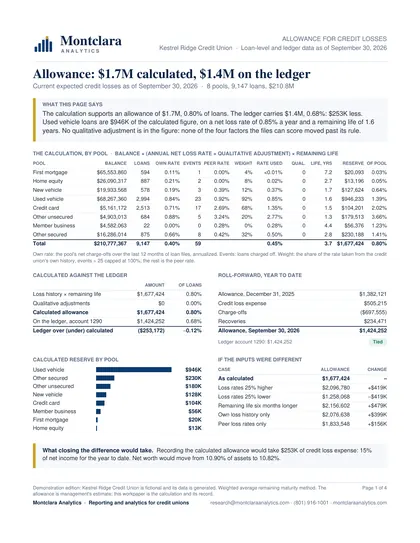
Kestrel Ridge's ledger, loan and share trials, member file and budget also built the board package, the Call Report workpapers and the allowance workpapers. All four are on one page.
Open the demonstration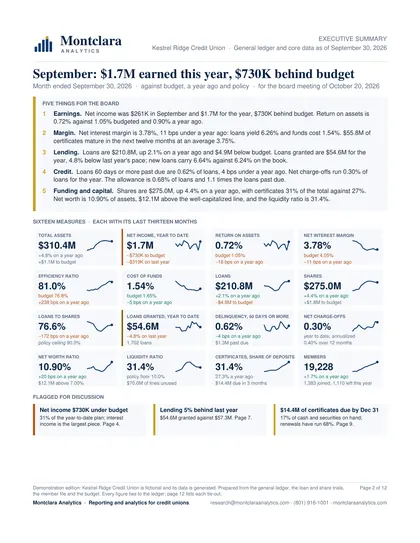
How the service works
A core conversion is the riskiest month-end a credit union will have. Data moves between systems with different field definitions, product codes and general ledger mappings; the reports built on the old core stop working; and the first board package and Call Report on the new system are produced while staff are still learning it. We start months ahead: inventory every recurring report, document how each figure is derived on the current core, and map those definitions to the new one. At each mock conversion we load both systems' data into the same model and reconcile members, shares, loans, delinquency and the GL account by account, so mapping errors surface while there is still time to fix them. After go-live, your board package, Call Report workbook and department reports come from the new core from the first month-end, with old-core history carried forward so trends don't break.
A fit if this sounds familiar
- Credit unions that have signed with a new core vendor and convert in the next 6 to 24 months, to Corelation KeyStone, Jack Henry Symitar, Fiserv DNA or another platform
- Finance teams whose reports depend on queries or spreadsheets written for the current core
- Institutions whose last conversion broke trend reporting or delayed a board package or Call Report
- Credit unions consolidating cores after a merger
Both cores run in the same data model from the first mock conversion, so every reconciliation compares like with like, and reporting moves to the new core the month it goes live.
Delinquency is the measure most often distorted by a conversion, because due-date and payment rules map differently between cores. This is the industry range it should still fall within after go-live.
Source: NCUA 5300 Call Report data, Q4 24–Q2 26, credit unions between $100M and $1B in assets. Montclara analysis.
Run for members, shares, loans and certificates at every mock conversion and at go-live.
Every unmatched account is listed by number for the conversion team.
Delinquency is where conversions most often drift, because due dates and payment rules are mapped differently.
The board package and Call Report workbook run on the new system from its first month-end.
Every engagement includes
- Report inventory and a definitions document covering how every recurring figure is derived today
- Field and product-code mapping from the old core to the new, reviewed against the vendor's conversion mapping
- Reconciliation at each mock conversion: members, shares, loans, delinquency and GL by account, with an exception list for your conversion team and vendor
- Go-live tie-out of member, share, loan and GL balances before you open on the new system
- Board package, Call Report workbook and department reports running on the new core from its first month-end
- Historical data carried into the model so three-year trends continue across the conversion
From agreement to live
Report inventory and definitions on your current core; your board package moves onto our data model first, so nothing changes for directors.
Both cores loaded into the same model and reconciled account by account; exceptions to your conversion team and the vendor within days.
Final tie-out of member, share, loan and GL balances before you open on the new system.
Reports run on the new core from the first month-end; the first quarter-end Call Report is reconciled to the last filing on the old one.
What it costs
Scoped to your conversion date, core and number of reports carried over; typically $15,000 to $40,000 depending on asset size and the number of mock conversions.
Clients on Professional or Enterprise receive conversion support at a reduced project fee, and their reporting continues without interruption on the new core.
Annual agreements billed monthly. A one-time implementation fee applies to packages, from $7,500; a 60-day evaluation engagement is available and credited against implementation. See all packages.
What finance teams ask
When should we start?
Six to twelve months before go-live is ideal: early enough to document definitions and move your reporting onto a neutral data model before the first mock conversion. We can start later, but the first reconciliation then lands closer to go-live.
Does this replace our core vendor's conversion team?
No. The vendor converts the data; we verify it from the reporting side and keep your reports working. The exception lists we produce are written so the vendor's team can act on them directly.
Which conversions do you support?
Any combination of Symitar, KeyStone, DNA, Portico, CU*BASE and other cores. The method is the same: read-only extracts from both systems loaded into one model, reconciled to the same totals.
What happens to our historical trends?
History from the old core is carried into the model and mapped to the new product and GL structure, so delinquency, growth and margin trends continue across the conversion date instead of starting over.
See it built on data from your core system.
A 30-minute walkthrough of a sample deliverable, or a complimentary board package preview for your credit union first.